

Q&A
In Conversation with
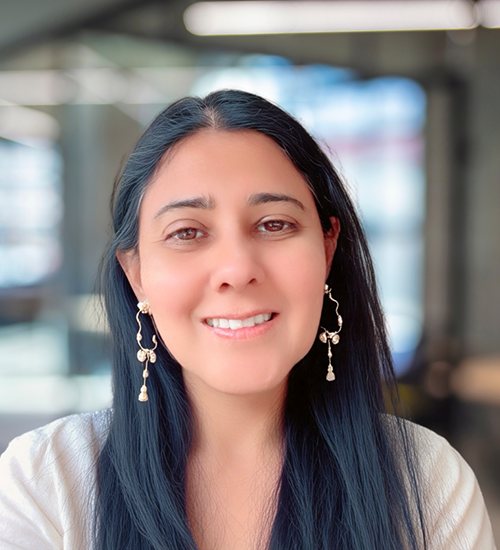
Alina Strelkovskaia
What's one thing people should know about your role or your work?
I'm an ultimate systems thinker - an architect of complex interrelations in digital learning innovation. My job is to hold strategic oversight at the intersection of content, technology and people, and to orchestrate meaning within that triangle.Digital learning isn't a self-contained process. It's embedded in a social context - institutional, economic, political, personal. On one side, there are industry markets dictating which skills are in demand;on another, institutional frameworks setting constraints and priorities on the learning provider's end. And in between are individual learners, with their cognitive patterns, needs and motivations.
Then comes technology: full of promise, yet infrastructurally constrained. Most of EdTech innovation unfolds within intricate legacy systems that pose engineering, data and integration challenges. As a digital learning strategist, I engage with all of these layers at once. My fundamental task is to keep the system in balance, ensuring that innovation doesn't collapse under its own complexity. In practice, this means a lot of cross-functional orchestration and bridging teams that rarely collaborate on a daily basis.
What lesson from your first job still guides you today?
I was 19, and it was a part-time teaching position in a language school. I was working with kids of various ages, characters and learning abilities. Some of them were easy to deal with. Some others - constantly tested my boundaries and required much attention.
That's where I learned my first two professional truths:
If something doesn't work as expected, it usually signals underinvestment of attention. Sometimes it's yours, sometimes you inherit it - but it's yours to rebalance now. This applies equally to people and systems.You can achieve extraordinary results through presence. Quality time, genuine attention and patient engagement create positive dynamics no framework can replace. With a problem - or a person (sometimes the same thing) - presence changes everything.
How do you define success in your current position?
My work is driven by meaning, that's the guiding star. Meaning can't be quantified, but there's an array of qualitative questions you can ask to keep your work in check.
Do these systems, solutions and architectures do the job? Does learning actually happen?
Does the learning outcome satisfy the needs of the beneficiary?
Is the tech resource-efficient and sustainable for your organisation?
What's the experience of people involved into the system development and maintenance: educators, engineers, content developers, business and institutional stakeholders? Are they happy to contribute to this system or is it a daily grind that fails to inspire or, even worse, feels exploitative?
Every 'no' points to work ahead. Every 'yes' deserves celebration.
Which skills have been most valuable to your success?
Discourse analysis, narrative design and metacognition. These come from a humanities background that trained me to see systems of meaning behind the systems of function.
Then, cross-functional experience: I've worked with editorial and platform teams, instructional designers, engineers, marketers, legal experts and external vendors. That's how you learn to speak everyone's language and align multiple realities into one shared goal.
On the practical side: digital literacy always pays off. Basic fluency in design, video editing, low-code tools and software engineering infrastructures gives you creative freedom. Understanding content marketing is essential too, as we all live in the economy of attention. It isn't enough to do great work, you also need to know how to make it visible.
And finally, writing skills. Despite the AI rise, I sincerely believe that it's the skill of the future. Writing teaches you to structure your thoughts, communicate nuance and adjust your communication style to cause and purpose.
What trends are shaping your industry right now?
Technology adoption - same old story since the printing press, just exponentially faster. The pace of technological development, and even more so the epistemological shifts it provokes in human thought and society, is unprecedented. As of 2025, the most pressing matter is AI and how it should be used in education. It's a complex topic that extends far beyond the basic question of 'how do I prompt GPT to do what I need instead what it thinks I need?'
At the ethical, didactical and product levels, it's about designing for learning with AI as opposed to learning from AI. And preserving the cognitive struggle that cultivates critical thinking, rather than offloading it to a tool. Fundamentally, it's about protecting learners from bias, disinformation and the silent exclusion of the vulnerable.
At the societal level, it's about preparing the next generations of kids and young adults for a 30-40 year-long career in the job market of radical ambiguity, while also nurturing them as decent human beings -capable of reflection and feeling, not just struggle for survival. And it's about supporting those whose established careers are already being disrupted, their life structures dissolving like castles of sand.
So yes, the industry is going through a tectonic shift. One that challenges our infrastructures, economies and the very conception of mind, meaning and learning. It's both terrifying and exhilarating, and we're all still learning to navigate it.
How would you describe your leadership style?
My default mode is balcony-level oversight - maintaining strategic vision while staying close enough to offer quality presence to every colleague I work with, regardless of title or experience. And when the situation calls for it, I'm happy to roll up my sleeves, dive into the details and provide all the hands-on support I can.
That said, I don't believe in a single, fixed leadership style you can wear like a pair of glasses. Good leadership is adaptive. Teams and individuals at different stages of their professional journey have different needs, and that's before you even consider cultural or generational differences.
You wouldn't wear a black-tie outfit to a picnic on the beach, or a Black Sabbath T-shirt to a ballroom. The same goes for leadership: it's effective when context-aware, responsive and attuned to the environment and people within it.
What's one challenge you turned into an opportunity?
Who said there was just one? Turning challenges into opportunities is practically a professional skill at this point - one I should have listed earlier.
I've faced many stumbling blocks of varying scale: delivering projects in profound contextual ambiguity, navigating career setbacks and dealing with personal losses. Some of those experiences were truly identity-shattering. Some of them demanded radical damage control, unconventional solutions and a fair share of courage. Ironically, those very experiences taught me to build at an entirely new level of quality and depth. I would also say that the ability to endure the struggle (indirectly quoting Ben Horowitz here!) and learn from it is intrinsic to professional success in innovation management. Working at a systemic level, you constantly face system resistance, especially at the early stages of modernisation. It's rare that you walk into a room, announce a revolution and everyone embraces it without doubt. Progress happens through friction, and wisdom to navigate it.
What advice would you give to someone just starting out?
Be thoughtfully curious. Explore you interests and learn across disciplines, with an open mind. But do it pragmatically, as passion alone is a shaky career foundation. Deepen your knowledge in one or two domains that hold genuine meaning to you. Work towards mastery - to the extent possible, without slipping into stubborn perfectionism and losing the joy of learning per se.
And above all, be kind. To the people you meet along the way and to yourself. The way you move through the world matters just as much as where you end up.


Begin
Ready to share your story?
Create a first-person Q&A profile of your own - a considered, lasting record entirely in your own words.